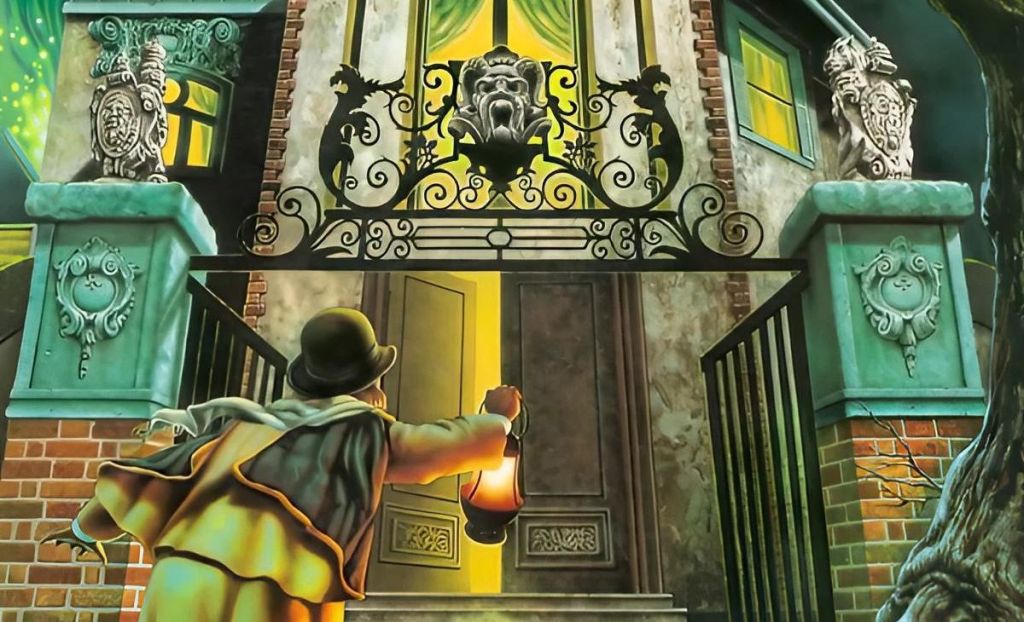
How Frédérick Raynal made and lost his horror masterpiece – the first 3D PC game.
This originally appeared in PC Gamer UK in December 2014.
The best horror stories retrace familiar fears; the unquiet dead, the unlikely hero, the revenant villain, the ancient manor. Similarly, the stories of our game-creating heroes retread familiar paths; the secret project, the team triumphing against the odds, the last-ditch effort, the evil management, the disaster averted. Alone in the Dark’s inception has all of these elements. Yet it also draws something from the movie industry and something from French culture.
The creator, and the project’s driving spirit, was Frederick Raynal. His story starts in his father’s small town video store in rural France. Young Frederick was, as he tells us in charming broken English, shy. “I had a talk with a psychologist, we were talking about Eric Chahi (Another World, From Dust), Paul Cuisset (Flashback) and myself, we are the same kind of guy, very introvert… when I was little boy, I make paper games, board games for my friend. Because I always have this feeling I meet someone that I don’t know what to say to him, and games were my way of saying ‘OK, let’s play!”
So Raynal started building games young, learning through a correspondence course to do electronics, then buying a ZX81 in kit form; “as a painter found a pencil or a sculptor a hammer and pick, I found my tool to make games.” Teaching himself from a book about the processor, Raynal fell out of love with formal education and in love with programming. After secondary school, he went to work in his father’s shop in Brive-La-Gaillard, fixing computers and selling videos. “I was living in the shop, literally,” he says, “Going to bed when completely dead, dealing with customers, then back to my computer. I was completely immersed.”
With this level of obsession, his first games from the age of 13 to 22 were ‘Laser‘ (1979), Robix 500 (1983) and Popcorn (1988). He distributed these on the nascent bulletin boards of the time and eventually fan letters started coming through the post – swiftly followed by two job offers while Raynal was doing his military service. One came from a big Parisian company and the other from the tiny Infogrames, based in Lyon. Small town boy Raynal went for Lyon because it was “a good compromise between a big town and a human town” he says. The company didn’t figure in his calculations. Raynal didn’t know anyone in Lyon. He’d also never worked in an office before. But he wasn’t perturbed by the move out of the video store because “there were computers! I feel well here.”
However, because he’d put his job title on the co-developed Popcorn as ‘graphisme’, Raynal had inadvertantly landed an artist role, so had to prove his skills. “They made me do a test. It was EGA, they wanted me to do a line function. I worked on it and optimised, and optimised. They said, ‘oh, it’s 800 times faster than ours.’ Okay, so I am a programmer.”
Raynal was working mainly on conversions and graphics design, including one game that caught his eye: Alpha-Waves, a polygonal platformer that was the first game in 3D. Raynal became convinced that the time was ripe for 3D games and, in his spare time, started working on what would become Alone in the Dark.
Working in his father’s video store had given Raynal the tastes of a film geek: he loved the horror films of George Romero and Dario Argento, and “the structure of that kind of movie, one guy entering an old manor…” he says. “Look at the headline on the Amityville Horror – the slogan for Alone in the Dark is written on it, ‘for God’s sake, just get out.” He’d also done a little pen & paper roleplaying, specifically Call of Cthulhu and, though he liked the theme, he hated the character sheets, which he found huge and difficult.
To simplify the game, he decided to set it in the 1920s and make you alone in an old haunted manor, so there was no electricity and no dialogue; just an adventure game with some action. His colleague, the artist Didier Chanfray, drew a polygonal structure for the first room in the game, whilst a trainee called Franck de Griolami helped with the programming. Already the gothic horror of Alone in the Dark was settling into place.
“My report will be ready in a couple of days. I’ve been reading up on the history of the old house, it’s the kind of place ghosts run away from in terror. Grisly murders, curses, lunacy… Luckily devil worship makes me smile, so this is my idea of a paid vacation.”
Raynal’s next step was to create all the technical tools needed for a 3D game. “Usually, I’d think about a game and do a prototype in two hours” says Raynal. “But I needed a 3D modeller [program]. But this was early 1991. I never saw a professional modeller!” He’d abandoned the concept of having 3D backgrounds taken from photos, because of the polygon limits he was working within (and because the conversion process, without digital cameras, was lengthy), but he was making 3D characters that moved with hand-painted 2D backdrops. Despite this, the 3Desk tools he made by himself, in a few days, contained all the core elements of modern 3D programs like Maya and 3DS Max, as well as letting him try out the animation on his characters.
To make the world look realistic, he needed an artist to fill in the blank polygons. He ran an internal contest at Infogrames, between the artists, giving them the wireframes to work from. Only two of them produced anything, and he settled on Yael Barroz, an art school graduate who was just leaving the company and wanted the work.
Quickly, Raynal created a generic character ‘Man_0’ – a “programmer’s crash test dummy – very simple because I needed something quickly.” By September that year, he could control a 3D character with the keyboard-and playing with this, in the polygonal test chamber, he quickly learned a lot about the problems camera angles can cause in 3D games-and what to avoid.
“The 12 polygon bird coming in the first window in the game. I showed that to Infogrames.” Infogrames in those days only employed 35 people, and had turned down all the previous pitches from this shy designer. But when they saw the 3D room, they approved it immediately. The starting team consisted of Raynal, Chanfray, Barroz (who started dating Raynal a month into the project, more on which later), and Griolami. With the aid of writer Franck Manzetti, they planned out the Manor. Meanwhile, Didier made the first monster and ‘Man_2’, AKA Edward Carnby, who was an unprecedented 40 polygons. The monster was what Raynal calls the ‘zombie chicken’, which used a sphere to have volume without using many polygons.
The second playable character, Emily Hartwood, was introduced later as Raynal thought he could get women to play the game by doing so; “I was very naive”, he says. “The story for the female character was supposed to be different, but we didn’t have time.” With a real hero and a real monster. Raynal now realised he needed a scripting language, so he wrote his own object-oriented one and put collision boxes around the creatures. By December 1991, they had a working room where you could push objects around, the monster would attack you and you could fight back, punching and kicking. Raynal even included a headbutt that was later stripped out.
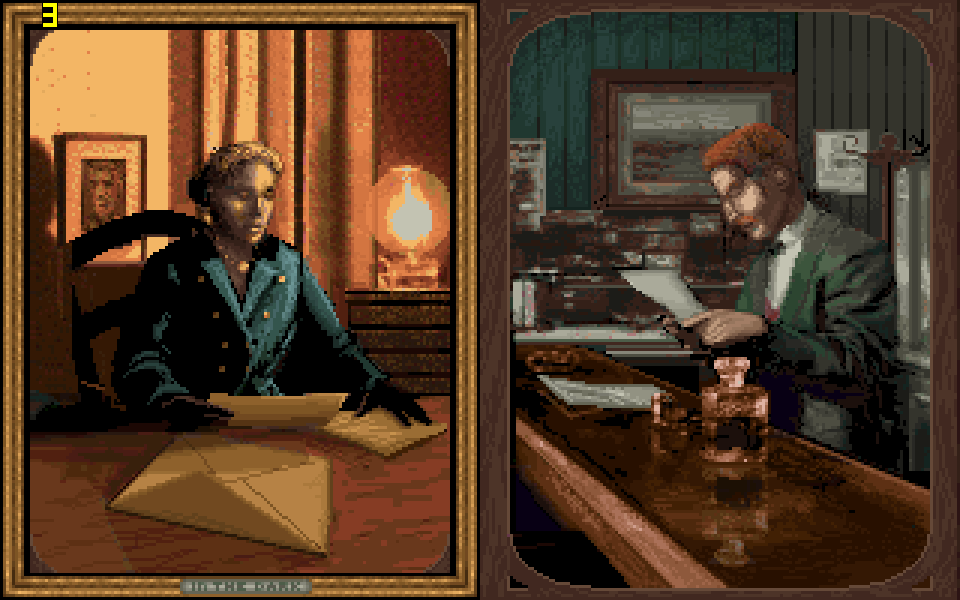
So the engine was ready and now they had to nail down what the game was actually going to be like. The team sat down for a three-day meeting. The new writer, Hubert Chardot, later told Raynal that he learnt his job in those three days. The team planned the storyline from start to end, made a complete task list for every person, and listed all the monsters, objects, animations and so on they needed to make. “We ate a lot of pizza,” recalls Raynal.
One of the key decisions to come from this was that merely walking around the Manor needed to be scary. From the unavoidable traps in the first area (a big design no-no these days) to the insta-death possible from reading some books or opening some doors, the player had to be stressed all the time. “As Lovecraft puts it, the oldest and strongest emotion of mankind is fear,” says Raynal, “and the strongest fear is of the unknown.”
On top of that, Raynal also made a simple path through the game; there was always a way to avoid fighting or to kill a monster with a single action, if you paid attention. For example, the pirate could parry any blow, unless you changed attack halfway through the swing. The seemingly invincible knight could be killed with the statuette, and a roomful of zombies could be distracted by a pot of soup.
With the project totally planned, they added two extra 2D artists and got to work. They also added Philippe Vachey – to do the sound. “At the beginning of the 90s, PCs were not good at doing sounds,” recalls Raynal, “but we got to use Sound Blaster audio samples, real samples. The squeaks, the steps the scream of the monster when you open the door.” As the sound was collision-based, every step sounded different depending on where you are.
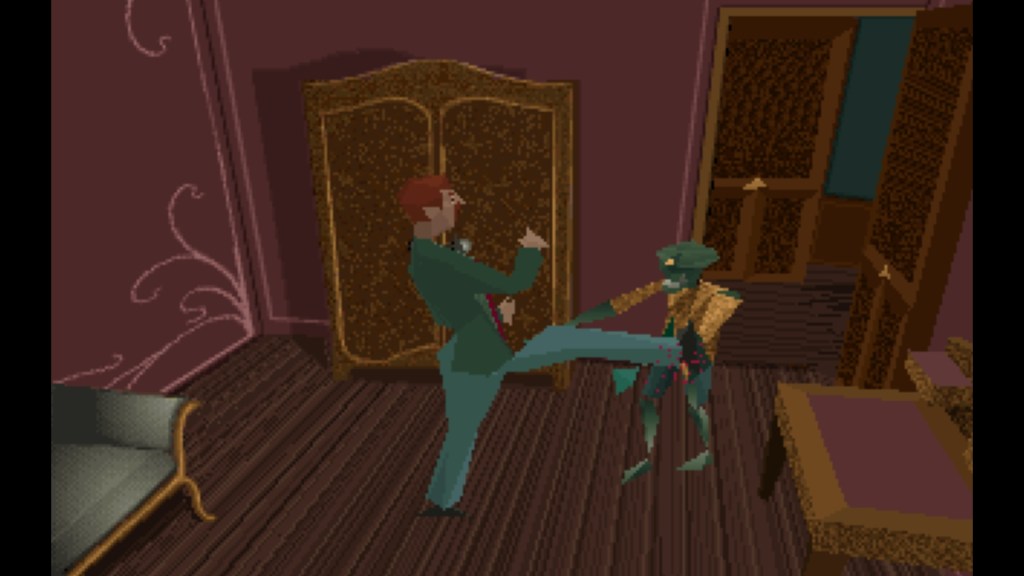
A problem arose in April 1992: the game was due out in November, so the advertising visuals needed to be confirmed, but the team had yet to give the lead character a head beyond a sphere. A simple solution was proposed; an artist hand-drew a face on, which never appeared in-game. Time pressures towards the end of the project meant that this faked image never got replaced; it ended up on the adverts, the box and in the in-game slideshow.
By October 1992, Raynal had been working 15 hour days for a year and, though the project was on schedule, they were cutting it fine. “I have a confession” Raynal tells us, “in October 1992, I hated this game.” At the beginning, everything was so exciting and impressive – but not by the end. “We didn’t do a lot of iteration. The first prototype was at the end of 1991 and we did the real content in eight months. We worked a lot and didn’t ask a lot of questions.”
The first indications that the game might review well were from a preview event for French journalists, a few days before release. “A few journalists came inside and they like it very, very much.” says Raynal “One journalist, I remember very well, I was doing the demonstration and I showed the character walking backwards and he did the same thing on his chair! ‘Wow, this is the first time in a game.’ Before this, no game had a character who can go backward. I was very afraid, but the journalists left me very, very surprised.”
So tight was the deadline, there was no time for polish and little time for bug-fixing. It was only on the night of release that Raynal, doing a final playthrough, realised the game was broken. “I give the four floppy disk, I play all night… (imitates panicked breathing)… I find a bug. You cannot finish the game.” He fixes the bug and, at 6am, he was waiting outside Infogrames offices. “They shout at me; ‘Why? What did you do?’ I am, ‘you cannot finish it! The trucks are already going with the game…” Thankfully, Infogrames took the decision to do a recall.
Indeed, his relations with Infogrames took a nose-dive immediately after the game was finished; “An important guy at Infogrames come to me and say, really literally, ‘I know how we’ll do a second one. Just modify a little the scenario, it will sell because it is number two!’ Oh! I really didn’t appreciate that.” Raynal would have been happy working another year of 15 hour days. “But being not honest with the player, I can’t.”
Raynal and his entire team left, setting up Adeline Software, under the auspices of the famous music publisher Paul de Senneville. They worked on the kooky Little Big Adventure games, and continue to work together, now at Ludoid, Raynal’s indie studio, where they’re attempting to reacquire the rights for Little Big Adventure 3. The French government made Raynal a Knight of Art and Literature in 2006, alongside Michel Ancel and Shigeru Miyamoto. They were the first video game developers to receive this distinction.
And Alone in the Dark? It sold and sold, eventually spawning two sequels along the lines Raynal feared, and eventually two series reboots. Infogrames employed 35 people when Raynal started his project; it had 300 when he left. Raynal to this day doesn’t know how the game sold; “I don’t know, as I left them and they really, really were not very good. Oh, yes, that’s a sad story. I never knew. I heard more than three million copies. In France, royalties were not something a publisher liked to do a lot, so l can’t tell.”
What does Raynal think of the game now? “Playing back the game, the things I hated then, I was completely wrong. I also found so many mistakes you can’t do nowadays. How did the players finish this? It was difficult anyway, even if you read all the books, because it was a time where there was no information for players… but it was another time. Not a lot of games existed at the time and the players were more technophile… the pleasure was to discover things, very often about the technology.”
The game released on PC, Mac and the long-dead 3DO, but Raynal preferred the PC version. Even today, the controls are surprisingly responsive. “When I first used it back in the 80s, I fell in love with it… ” he says, misty-eyed, “I would like an HD remake one day and I hope it will happen. But Infogrames owns the rights.” Given Raynal’s attempts to reclaim Little Big Adventure, we wouldn’t write off the possibility.
GAMEOGRAPHY
- POPCORN (1988) Developed by Christopher Lacaze, with Raynal doing the graphics duties, this game was programmed in assembly language to run on an 8MHz processor. Despite this, it can still run perfectly well on modern PCS – if you can find it!
- LITTLE BIG ADVENTURE (1994) Contemporary with Alone in the Dark 3, Raynal and Adeline released the delightful, bizarre LBA, a fantastical multi-species dystopia involving rebellion, magic balls and prophecies, with a hero called Twinsen. “LBA was a lot inspired by Zelda”, Raynal tells us, and was intended for SNES.
- TIME COMMANDO (1996) It’s easy to overuse the word bizarre with Raynal’s games, but this time-leaping combat game featured a huge arsenal of period-appropriate weapons in each of its bizarre settings. It was released on PC and PS2. The ultimate weapon was…a yo-yo.
- LITTLE BIG ADVENTURE 2 (1997) Even more bizarre than the first game, LBAZ replaced the hand-drawn 2D backgrounds with fully 3D outdoor environments. It was extremely large and varied, with multiple planets to visit and featured relatively advanced enemy Al. It sold 600,000 copies worldwide.
 {funambulism}
Leave a comment